Why Choose PVC Masks for Global Procurement?
Global procurement teams often seek protective products that balance cost, consistency, and practical performance. A Pvc Mask can meet these needs when its design matches the intended environment. PVC offers a smooth surface, flexible handling, and straightforward cleaning for suitable applications. It is not a universal solution. That matters.
Experienced buyers evaluate more than unit price. They review material specifications, dimensions, filtration or splash claims, fastening quality, packaging, and batch consistency. Supplier audits can reveal whether production controls are stable. Samples should be tested by intended users, not only inspected on a table. A mask that feels secure during a short fitting may become uncomfortable after several hours. Small details matter, including strap tension, edge finishing, odor, visibility, and carton protection. Procurement records should connect each shipment with production dates and inspection results. Clear communication also reduces surprises across languages, time zones, and shipping arrangements.
Reliable sourcing depends on evidence. Ask suppliers for current technical documents, quality certificates, test reports, and traceable product identification. Verify that claims fit the destination market and the product’s actual use. Requirements can differ between workplaces, regions, and exposure conditions. Buyers should also confirm storage limits, cleaning guidance, lead times, and replacement policies. The cheapest offer may create hidden costs through returns or inconsistent supply. Yet higher pricing does not automatically prove better quality. That assumption deserves challenge. A balanced comparison uses measurable criteria, realistic samples, and documented supplier responses. With this disciplined approach, global teams can judge whether a Pvc Mask supports safe, efficient, and dependable procurement.
PVC Masks: Materials, Structure, and Core Characteristics
For global procurement, understanding PVC masks starts with the material, not the carton.
PVC is a thermoplastic polymer valued for its smooth surface, flexibility, and stable shape. Its thickness influences comfort, durability, and visibility. Thicker film may resist tearing, but it can also feel warmer and less flexible.
That trade-off matters.
Clear PVC offers a clean appearance and allows quick visual inspection.
However, clarity should not replace performance testing. During sample checks, I examine surface defects, uneven coloring, sharp edges, and strong odors. A noticeable odor can come from additives or poor processing. It is not always a failure, but it deserves investigation. Material softness also varies between suppliers, even when specifications appear identical.
This detail is easy to miss.
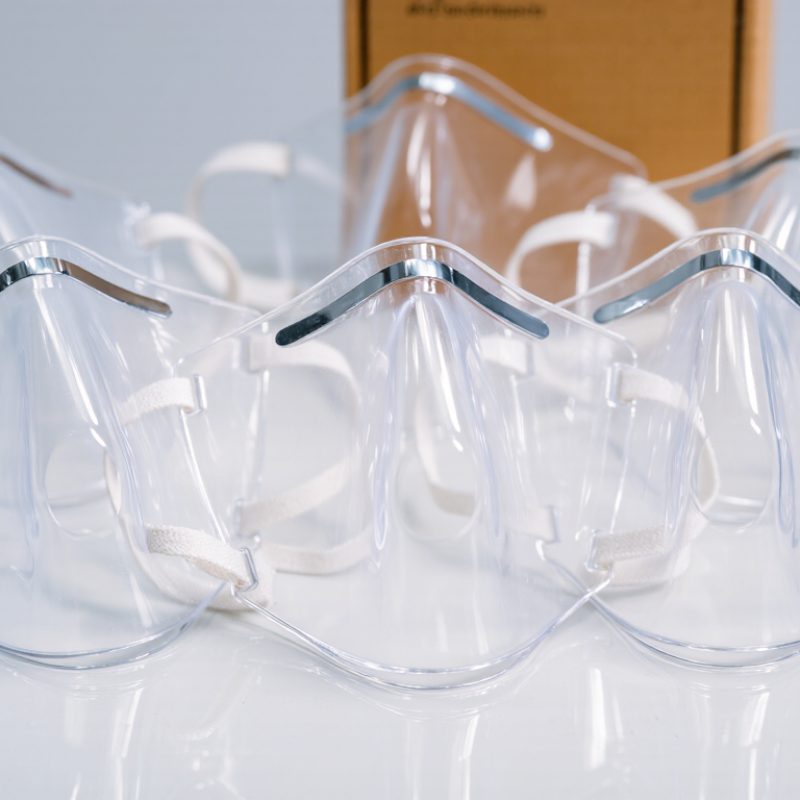
A typical PVC mask contains a molded or flat film body, sealed edges, ear loops, and sometimes a nose bridge. Heat-sealed seams should look continuous, without gaps or loose corners. Ear loops need consistent attachment and moderate elasticity. A weak connection can fail before the PVC film shows damage. The nose area should sit steadily without creating excessive pressure. I also compare measurements across random samples, rather than trusting one perfect piece.
Earlier, I assumed thicker masks were automatically better. That was too simple. Procurement teams should request material details, dimensional tolerances, production samples, and relevant independent test records. Destination-market requirements must also be checked before shipment.
Key Benefits for International Procurement and Supply Planning
Why Choose PVC Masks for Global Procurement?
For international buyers, PVC masks offer predictable production and practical supply planning.
The material is moldable, water-resistant, and suitable for repeatable shapes, colors, and surface details. These features help procurement teams standardize samples across factories. PVC also tolerates normal warehouse handling better than many thin fabric alternatives.
However, material grade matters. A soft mask may perform poorly in heat, while rigid PVC can feel uncomfortable during long use. That trade-off deserves testing.
UNCTAD reports that over 80% of global merchandise trade by volume moves by sea.
Therefore, packaging efficiency and shipment timing directly affect landed cost. PVC masks can be packed in nested units or flat protective bags, reducing wasted carton space when the design allows it. Buyers should confirm carton dimensions, gross weight, moisture protection, and loading quantities before approving a purchase order.
Small errors become expensive across a full container.
Supply planning also benefits from measurable controls.
A procurement specification should define PVC thickness, hardness, color tolerance, odor limits, edge finishing, and inspection samples. Independent quality checks can verify dimensions and surface defects before dispatch. Industry market reports often forecast continued growth in protective and reusable mask categories, but their classifications vary widely. They should guide planning, not replace purchase data.
One weakness remains: recycled-content claims require traceable evidence. Ask for test reports, batch records, and clear declarations. Do not rely on attractive samples alone.
Applications Across Healthcare, Industry, and Consumer Markets
Why Choose PVC Masks for Global Procurement?
PVC masks serve different needs across healthcare, industry, and consumer markets. In healthcare, transparent PVC can support visual communication during examinations. Its smooth surface also allows careful cleaning between uses. The World Health Organization’s 2020 supply forecast estimated demand for 89 million medical masks monthly during the pandemic. That figure exposed the importance of stable materials and scalable production. However, PVC alone does not guarantee filtration or respiratory protection.
Industrial applications require a more specific assessment. PVC can resist moisture and some chemical splashes, making it useful for laboratory work, processing areas, and maintenance tasks. NIOSH certification guidance states that N95 respirators must achieve at least 95% filtration efficiency. A simple PVC mask cannot automatically meet that standard. Fit matters. Procurement teams should verify testing, sealing, visibility, and compatibility with other protective equipment. The material may also fog under heat. That weakness can affect real workplace performance.
Consumer markets value reusable products, clear visibility, and easy maintenance. A transparent PVC face covering may help customers communicate in retail, education, and service environments. A 2023 market analysis by Grand View Research identified healthcare, industrial, and household use as major face-mask demand segments. Buyers should review thickness, plasticizer safety, cleaning instructions, and packaging conditions. Lower cost can look attractive, but brittle edges and poor ventilation create avoidable problems. Not always. Product data should guide the purchase.
Why Choose PVC Masks for Global Procurement?
PVC is used in transparent face shields, splash-resistant protective equipment, and selected reusable or disposable mask components. However, filtration performance depends on the finished product design and its tested standard—not on PVC alone.
The chart compares relevant filtration benchmarks: EN 14683 Type I surgical masks require at least 95% bacterial filtration efficiency, while EN 149 FFP2 filtering facepieces require at least 94% particle filtration efficiency under specified test conditions. Consumer face coverings do not have one universal global filtration requirement.
Sources: EN 14683:2019+A1:2019 and EN 149:2001+A1:2009. Requirements vary by jurisdiction and product category.
Quality Standards, Safety Requirements, and Supplier Evaluation
Why Choose PVC Masks for Global Procurement?
Global procurement of PVC masks needs more than a low unit price. PVC offers visible, wipeable surfaces and stable shaping, but material choice does not prove protection. Define the intended use before requesting quotations. For medical applications, verify requirements such as EN 14683 or ASTM F2100. Request independent test reports for filtration, breathability, splash resistance, and biocompatibility where relevant. The WHO 2020 COVID-19 Supply Chain System estimated a monthly need for 89 million medical masks during the emergency. That scale revealed a practical lesson: weak documentation can disrupt supply as quickly as limited factory capacity.
A reliable supplier should provide batch traceability, material declarations, inspection records, and a corrective-action process. Ask whether the PVC is virgin or recycled. Check plasticizer and skin-contact safety evidence. For transparent designs, inspect optical clarity, seal quality, edge finishing, and fogging performance. Audit production samples, not only catalog photos. ISO 13485 certification can support process control, but it does not replace product-specific testing. Compare lead times, sampling rules, change-control policies, and shipment inspection results. One weakness remains. Buyers sometimes accept an impressive certificate without checking its scope or validity.
Tips:
Use a weighted scorecard. Give safety and traceability more weight than price. Request three production samples. Test them after cleaning cycles. Record failures honestly. Small cracks, odor, or loose straps may indicate larger batch risks.
Cost, Customization, Logistics, and Sustainability Considerations
Why Choose PVC Masks for Global Procurement?
Cost, Customization, Logistics, and Sustainability Considerations
PVC masks can support global procurement when buyers need repeatable shapes, vivid colors, and controlled unit costs. The material suits molded details, transparent sections, textured surfaces, and logo-free custom patterns. In practice, tooling creates the largest early expense. Larger orders usually spread that cost across more units. However, low-volume projects may not achieve the expected savings. A prototype can reveal weak edges, odor, or uncomfortable pressure points before mass production.
Logistics also deserves close attention. Maritime transport carries over 80% of global merchandise trade by volume, according to UNCTAD’s Review of Maritime Transport 2023. PVC masks are compact, but cartons still need accurate stacking plans. Buyers should compare product volume, packaging strength, minimum order quantities, and delivery buffers. A cheaper factory price can disappear through oversized cartons or urgent air freight. That happens more often than procurement teams admit.
Sustainability requires honest limits. The OECD’s Global Plastics Outlook projects annual plastic waste could nearly triple by 2060, reaching about 1,014 million tonnes. PVC sourcing should therefore include material declarations, restricted-substance testing, durable design, and practical end-of-life instructions. Recycled content may reduce virgin material demand, but it can affect color consistency and surface quality. Recycling availability also varies sharply by country. The uncomfortable question remains: will the mask be used repeatedly, or discarded after one event? Cost, customization, logistics, and environmental performance must be measured together.